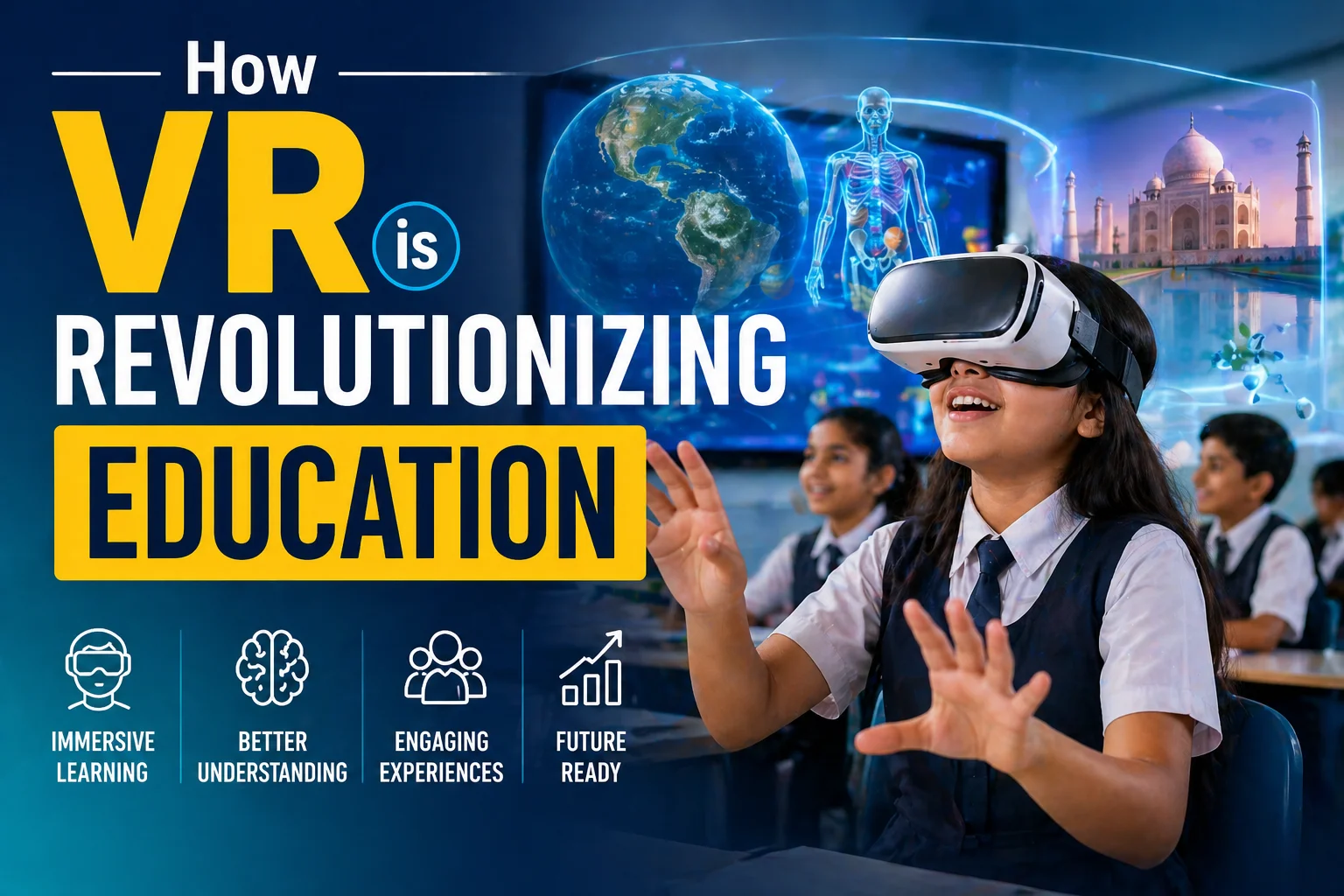
The education sector is undergoing a major transformation, driven by rapid advancements in technology. Among the most exciting innovations is Virtual Reality (VR)—a powerful tool that is redefining how students learn and interact with information.
VR is no longer limited to gaming or entertainment. It has emerged as a game-changer in education, offering immersive and interactive experiences that go far beyond traditional teaching methods.
🚀 What is Virtual Reality in Education?
Virtual Reality (VR) is a technology that creates a simulated, 3D environment where users can interact with digital objects in a realistic way. In education, VR allows students to step inside a virtual world—whether it’s exploring the human body, visiting historical landmarks, or conducting science experiments.
Instead of just reading or watching, students can now experience learning firsthand, making education more engaging and impactful.
🎯 Why VR is Transforming Learning
1. Immersive Learning Experience
Traditional classrooms often rely on textbooks and lectures. VR changes this by creating immersive environments where students feel like they are part of the lesson. For example, instead of learning about space from a book, students can virtually travel through the solar system.
2. Better Understanding of Complex Concepts
Subjects like science, medicine, and engineering often involve complex concepts that are difficult to visualize. VR simplifies these by providing 3D models and simulations, helping students understand topics more clearly.
3. Increased Student Engagement
One of the biggest challenges in education is keeping students engaged. VR captures attention by making learning interactive and exciting. When students actively participate, they are more likely to retain information and stay interested.
4. Safe Learning Environment
VR allows students to perform experiments and simulations in a risk-free environment. For example, medical students can practice surgeries or science students can conduct chemical experiments without any real-world danger.
5. Learning Beyond Boundaries
With VR, geography is no longer a limitation. Students can visit historical sites, museums, or even other countries without leaving the classroom. This opens up global learning opportunities.
🧠 Real-World Applications of VR in Education
🧪 Science and Medicine
Students can explore the human body in 3D, understand anatomy in detail, and even simulate surgical procedures.
🏛️ History and Geography
VR allows students to visit ancient civilizations, monuments, and historical events, making history come alive.
🛠️ Technical and Skill-Based Training
Industries like engineering, aviation, and manufacturing use VR for hands-on training and simulations.
📚 Classroom Learning
Teachers can use VR to make lessons more interactive, whether it’s visualizing complex diagrams or conducting virtual field trips.
🌍 Impact of VR on Indian Education
In India, VR is gradually becoming a part of modern education systems, especially in private schools and advanced institutions. With the rise of EdTech platforms, VR-based learning is becoming more accessible.
Government initiatives and digital education programs are also encouraging the adoption of advanced technologies, helping bridge the gap between traditional and modern learning methods.
However, widespread adoption still faces challenges such as cost, infrastructure, and awareness. As technology becomes more affordable, VR is expected to play a major role in shaping the future of education in India.
⚠️ Challenges of Implementing VR
While VR offers many benefits, there are some challenges:
- High initial setup cost
- Need for proper hardware and infrastructure
- Lack of trained educators
- Limited access in rural areas
Overcoming these challenges will be key to making VR a mainstream educational tool.
🔮 The Future of VR in Education
The future of VR in education looks extremely promising. As technology continues to evolve, VR will become more affordable, accessible, and powerful.
We can expect:
✔ Fully immersive virtual classrooms
✔ AI-powered personalized VR learning
✔ Integration with augmented reality (AR)
✔ Wider adoption across schools and colleges
VR will not just enhance education—it will transform how knowledge is delivered and experienced.
🏁 Conclusion
Virtual Reality is revolutionizing education by making learning more immersive, interactive, and effective. It moves beyond traditional methods and provides students with real-world experiences in a virtual environment.
As adoption increases, VR will play a crucial role in creating a future-ready education system, where students learn not just by reading—but by experiencing.
In a world that is rapidly evolving, VR ensures that education keeps pace, preparing students for the challenges of tomorrow.